From 2008 to 2013, Art & Document was the voice of the Center for Documentary Arts, a nonprofit project founded by Timothy Cahill at the Sage Colleges of upstate New York. Situated at the crossroads of art, ethics, faith, and conscience, the blog served the Center's mission to present artists, writers, and thinkers whose lives and works partake of the sacred, bear witness to suffering and hope, and manifest beauty, dignity, charity, and truth.

23 October 2010

Battlesight: Installation

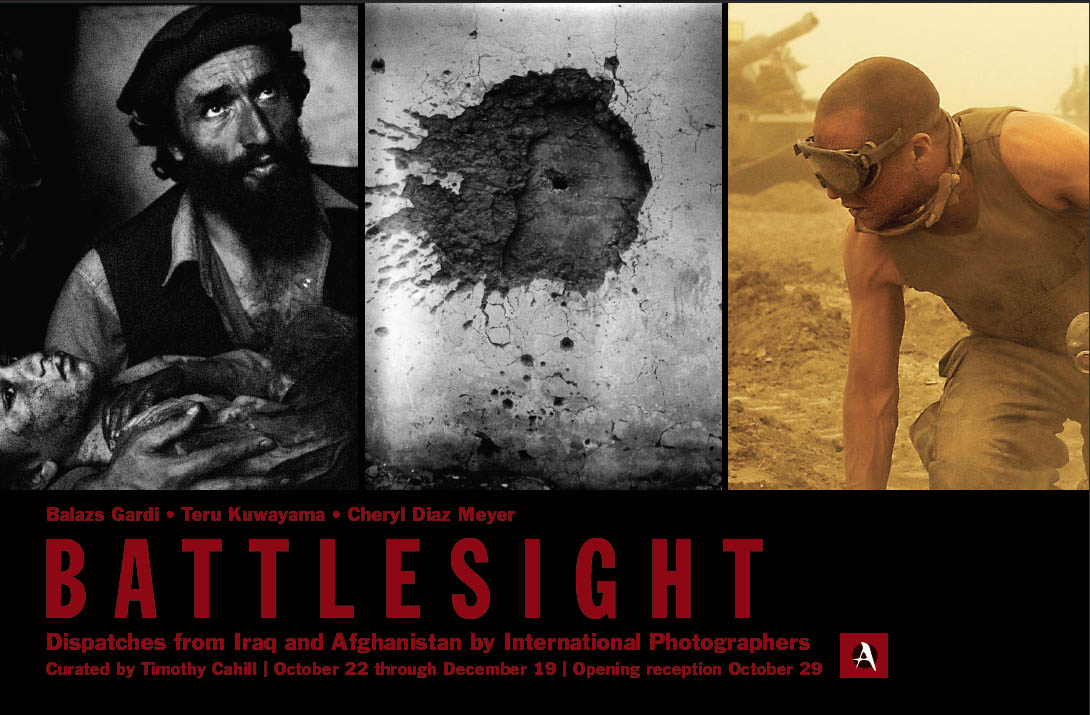
Battlesight: Dispatches from Iraq and Afghanistan by International Photographers
The Arts Center of the Capital Region, October 22 through December 19, 2010
Opening reception, October 29, 5-9 pm

22 October 2010

Press: The Troy Record

The Troy Record, October 21, 2010


Art Center explores wars’ savage beauty


By Phil Drew
The Record
A man clutches a wounded child; both are grimy, peering out of darkness in the black and white photo. The man’s gaze is not toward the combat photographer who has snapped the image — embedded with U.S. troops fighting in the mountains and villages of eastern Afghanistan — but somewhere upward; toward an unseen soldier towering behind the cameraman, perhaps? Toward a bystander? Toward heaven?

Despite obviously severe wounds, the child appears calm, if grim, gaze directed the way as his protector’s. Are they imploring, accusing? Or simply presenting themselves to their unseen interlocutor, heavenly or worldly, proclaiming, ‘here I am,’ ‘deal with me?’ Crouching next to them, an older man touches the child; a doctor giving treatment? A village elder? A mullah? The youngster’s grandfather?

 There is something almost spiritual in the pose of man and child, reminiscent of the ‘Pieta’ yet shockingly contemporary. And the man laying on hands? "Something almost, dare I say it, rabbinical about that," says Timothy Cahill, showing off the image by photojournalist Balasz Gardi – one of three independent photographers whose work is on display through Dec. 19 in the main gallery of downtown Troy’s Arts Center of the Capital Region.

 "These pictures bring us to empathy," says Cahill. "It’s impossible to look at these photographs, to really look at them, and not, after going around the room, to feel connected with these other human beings."

Gardi’s work, along with that of Cheryl Diaz Meyer and Teru Kuwayama, makes up "Battlesight: Dispatches from Iraq and Afghanistan by International Photographers" – sponsored by the year-old Center for Documentary Arts at The Sage Colleges.

The images, curated by Cahill, the center’s founding director, are artful, beautiful photography, worthy of a gallery; but they are also reportage, unblinking, close-up, of the effects of war, psychological and physical and visceral. Their combined effect is not polemical and argumentative but a jolt of reality: "it strips us of abstraction," says Cahill.

Read full article here

05 October 2010

Press Release


For Immediate Release 
October 4, 2010 
Battlesight: Dispatches from Iraq and Afghanistan by International Photographers
October 22 – December 19 Reception: Friday, October 29, 5:30 – 9:00 P.M.

Free and Open to the Public

Presented by the Center for Documentary Arts in cooperation with The Arts Center of the Capital Region. 

Curated by Timothy Cahill

TROY, NY – The Arts Center of the Capital Region and the Center for Documentary Arts at The Sage Colleges is pleased to present Battlesight: Dispatches from Iraq and Afghanistan by International Photographers, a new documentary photography exhibit opening in mid‐October. The exhibit is a powerful collection of wartime images from Iraq, Afghanistan, and beyond by three renowned photographers whose work records the realities of life for combatants and civilians alike in lands far from most Americans’ view. The photographers, Cheryl Diaz Meyer, Balazs Gardi, and Teru Kuwayama, all international award recipients, represent a variety of approaches to contemporary photojournalism, from traditional news reportage to intimately interpretative documentary art. Battlesight is organized by Timothy Cahill, director of the Center for Documentary Arts, in cooperation with the Arts Center of the Capital Region and the Sage Colleges’ “Veterans Week 2010.”


Cheryl Diaz Meyer Dust Storm, Second Tank 
Battalion, U.S. Marines,  Iraq, 2003
Cheryl Diaz Meyer shared the 2004 Pulitzer Prize for Breaking News Photography with David Leeson for their “eloquent photographs depicting both the violence and poignancy of the war with Iraq,” made while both were senior staff photographers at The Dallas Morning News. Diaz Meyer covered the US‐led invasion of Iraq as an embedded journalist attached to the Second Tank Battalion of the First Marine Division. After the fall of Baghdad, she continued to cover the aftermath as a unilateral journalist. She has returned to Iraq numerous times, to cover the capture of Saddam Hussein and the infamous “spider hole,” the Al Mehdi death squads, the Iranian infiltration into Basra, and the regions tormented women, who set themselves on fire in an ancient practice of self-immolation. Diaz Meyer's work in Iraq was also awarded the Visa D’Or Daily Press Award 2003 at Visa Pour L’Image in Perpignan, France.


Balazs Gardi, Afghan man and wounded boy, 
Korengal Valley, Kunar Province, East Afghanistan,  2007
Balazs Gardi is a Hungarian photographer who documents the everyday life of marginalized peoples and communities facing humanitarian crises. He has photographed the effects of war in Afghanistan and Pakistan both as a unilateral journalist and embedded with troops from the United States, Canada, and Britain. His current long‐term project, “Facing Water Crisis,” examines, as he writes, “the vital yet destructive presence, crippling absence and strategic value of water worldwide.” Now working independently, Gardi was staff photographer at Nepszabadsag, Hungary’s largest national daily, from 1996 to 2003. He studied journalism and photography in Budapest and at the University of Wales, Cardiff. Among his numerous honors are the Prix Bayeux War Correspondents Award, the PX3 Photographer of the Year Award, three World Press Photo awards, a PDN Photography Prize, and the Global Vision Award from Pictures of the Year International. He is the recipient of grants from the Alexia Foundation for World Peace and Getty Images. He has photographed the effects of war in Afghanistan and Pakistan both as a unilateral journalist and embedded with troops from the United States, Canada, and Britain. His current long‐term project, “Facing Water Crises,” examines, as he writes, “the vital yet destructive presence, crippling absence and strategic value of water worldwide.” Now working independently, Gardi was staff photographer at Nepszabadsag, Hungary’s largest national daily, from 1996 to 2003. He studied journalism and photography in Budapest and at the University of Wales, Cardiff. Among his numerous honors are the Prix Bayeux War Correspondents Award, the PX3 Photographer of the Year Award, three World Press Photo awards, a PDN Photography Prize, and the Global Vision Award from Pictures of the Year International. He is the recipient of grants from the Alexia Foundation for World Peace and Getty Images.


Teru Kuwayama has published photographs in Time, Newsweek, National Geographic, Outside, Fortune, and Vibe, among other publications. His work on the Tibetan refugee diaspora received awards from the New York Foundation for the Arts and the Alexia Foundation for World Peace, and were exhibited at the United Nations and the Open Society Institute. The University at Albany graduate was named by Esquire as among the “Best and Brightest” of his generation for his reportage on the occupation of Iraq, and PDN included his work on Kashmir in a selection of 2005’s most iconic images in contemporary photography. In 2006 he received a Nikon Storyteller Award, a Days Japan International Photojournalism Award, and a W. Eugene Smith fellowship for his work in Afghanistan and northern Pakistan. Kuwayama is co‐founder of Lightstalkers, a professional and social network of photographers, media professionals, NGO workers, military personnel, and other “unconventional travelers.” He recently completed a Knight Fellowship at Stanford University and received a 2010 Knight News Challenge award. He is currently a 2010 TED Global Fellow and 2010 Ochberg Fellowship at Columbia University's DART Center for Journalism & Trauma.

.


Teru Kuwayama, The ruins of Kabul, Afghanistan, 2002 


Timothy Cahill is founding director of the Center for Documentary Arts at The Sage Colleges, a cultural/educational initiative for using art to raise humanitarian awareness and foster compassion. The Center for Documentary Arts, established in 2009, defines “documentary art” as those narrative forms of photography, film, oral history, theater, painting, poetry, etc. that address social themes and bears witness to the human condition. The Center’s conviction is that this “witnessing art” is a vital tool for stimulating personal empathy and collective engagement. In addition to his work at CDA, Mr. Cahill is a writer, editor, and visual artist. He was the art critic and cultural reporter for the Albany Times Union from 1996 to 2006, and art correspondent for the Christian Science Monitor from 1995–2007. His writing has won numerous awards and honors, including a National Arts Journalism Program mid‐career fellowship at Columbia University. Mr. Cahill has exhibited his photography in journals, galleries, and museums. His photographs are in the permanent collection of the Albany Institute of History and Art.


Gallery Hours
Monday – Thursday | 11AM – 7PM 

Friday + Saturday | 9AM – 5PM 
Sunday | 12 – 4PM


About The Arts Center: For nearly 50 years, The Arts Center of the Capital Region has enriched the lives of hundreds of thousands of people. A regional arts center, it offers classes, camps, exhibits and performing arts events. Artists of all ages and abilities are encouraged, mentored, and nurtured in a collaborative, supporting and accepting environment.

The Arts Center’s 36,000 square feet of space include discipline‐specific studios for pottery, printmaking, culinary arts, jewelry making, woodworking, painting and drawing, stained glass and dance, among others. It also includes a 99‐seat theater for performing arts events, and its three galleries are noted for their critically acclaimed contemporary exhibits.

Learn more about The Arts Center of the Capital Region and its offerings at www.artscenteronline.org .


Contacts: 
Timothy Cahill, Curator and Director of the Center for Documentary Arts 
(518) 292‐1951 

Caroline Corrigan, Exhibits Manager at The Arts Center of the Capital Region 
518.273.0552 x 222 


15 September 2010

Homestretch

We are halfway through our monthlong campaign to match the $10,000 challenge grant from Chet and Karen Opalka (see previous post, "A $10,000 Vote of Confidence," for details). Our goal is to double their gift by the end of September, and interest has been steadily increasing as a number of new supporters have come in to help with the effort.  Every dollar we raise effectively becomes two when placed beside the Opalka funds. Thank you to everyone who has assisted, and welcome to all who will join in.


 Balazs Gardi, Afghan man holds a wounded boy
 outside their house in Yaka China village, Korengal Valley,
Kunar Province,  East Afghanistan, October 2007

The funds are certainly appreciated now that we have moved into the production phase for the exhibition Battlesight.  If you're new to the blog, please see the Pages section of the sidebar to read about this exciting exhibit featuring three international photographers covering the wars in Iraq and Afghanistan.  This is not a pre-existing or traveling show, but an original exhibit organized by the Center for Documentary Arts for the Capital Region.  The show will feature new prints of all the images, printed by NancyScans Corporation in Chatham, New York. These are the same folks who printed the photographs for Richard Prince's 30-year retrospective at the Guggenheim three years ago, and the quality is stunning. The images themselves are powerful and important. The photographers--Cheryl Diaz Meyer, Balazs Gardi, and Teru Kuwayama--bear witness to the reality of war for combatants and civilians alike. There are moments of courage, of suffering, of heroic endurance and grace. 


Battlesight opens October 22 at the Arts Center of the Capital Region in Troy, New York, with the public reception on Troy Night Out, October 29. The show runs through December 19. 


Cheryl Diaz Meyer, US Marine Corporal Richard
Cope, 23, of Michaigan,  enjoys the scent of a rose
from the gardens of Baghdad College, April, 2003 

Shows of this technical and artistic caliber seldom originate in the Capital Region, and I am looking forward to presenting this work here first.  My hope is that from Troy we will be able to travel the exhibit to other venues outside the region. Arrangements for that are in the works. I am in the homestretch with preparations, overseeing the framing, preparing the catalog, contacting the press, planning events. Lots of work, but it is a privilege and a joy to be doing it on behalf of the artists and their extraordinary work.


Teru Kuwayama, Ruins of Kabul, Afghanistan, 2002


Save the dates: Battlesight is organized in collaboration with the five-day conference Veterans Week 2010, organized by The Sage Colleges for November 8-12. For more information, follow the Veterans Week 2010 link in the sidebar. On December 9, the Center for Documentary Arts will hold a symposium at the Arts Center on battlefield photography featuring three generations of war photographers, from World War II to the present.  I will post details about that event as it gets closer.


Thank you everyone for your interest and support.


12 August 2010

A $10,000 vote of confidence

As a small start-up nonprofit, the Center for Documentary Arts at The Sage Colleges deals with the same challenges many cultural organizations face, struggling against the vicissitudes of a sluggish economy and declining philanthropic resources. The Center was initially conceived in the fall of 2008, just as the financial bottom fell out of the US economy and we were facing the very real possibility of a new Depression. The winner-take-all ethos of mid-decade gave way to a growing awareness of America’s vast population of have-nots, which was growing every day as people lost houses and jobs. A period of collective concern emerged for the hardships of others, hardships many of us worried might be ours tomorrow. The decision was made to move forward with the Center for Documentary Arts, with a mission to foster and stimulate this emergent empathy through the power of art.


It took a year from that point to officially launch the Center with The Sage Colleges as our host. I am looking forward to my first anniversary in November by preparing exciting programming for the coming fall and beyond. We are just about to go public with a series of offerings in the months ahead, including an eloquent collection of children’s art from Vietnam, a moving and inspiring portrait exhibition of burn survivors by photographer Steve Lobel, and a documentary film series at an exciting public venue.

These programs are in addition to the Center’s major initiative of the Fall 2010 season, Battlesight, an original exhibition featuring the work of three world-class battlefield photographers, one a Pulitzer Prize winner, who have covered the wars in Iraq and Afghanistan. These are images you won’t find on TV or in most publications; stark, powerful, haunting views of the wars we’ve been waging for nearly a decade.  There’s a wealth of information about the show and participating photographers on the Battlesight page and links, both on the sidebar, and I invite you to spend some time looking.

Mounting an exhibit of this importance requires a sizeable financial commitment, which brings me back to where I began, thinking about fund-raising. One of the realities of an arts administrator’s job constantly attempting to attract money. The Center relies entirely on individuals and organizations who believe in our cause, and slowly over the past months has found a small-but-growing number of such generous souls, bless them all. Recently, our fund-raising efforts were raised to a new level with a single stroke, when prominent cultural philanthropists Chet and Karen Opalka announced a major gift of $10,000, with the challenge that we match the amount before the end of September.

Chet and Karen Opalka
This is an extraordinary gift, both for the material support it provides and the huge vote of confidence it represents for our vision and activity. I am more than a little overwhelmed by the Opalkas' generosity, as I have been by the open hand of all those who have come aboard to aid us. Now I am inviting anyone and everyone interested in our work to join the Opalkas, our other donors, The Sage Colleges, and myself as we move ahead to Battlesight and the future. In the immediate term, contributions will help cover the costs of printing and framing the exhibition, creating gallery labels and an exhibit catalog, transporting and lodging the artists for public programs, spreading the word about the exhibit, and other expenses.  Remaining resources will be used to support the Center's mission.

As we cross the threshold into new levels of growth and accomplishment, this is an exciting time at the Center for Documentary Arts. If you can help with a tax-deductible donation in any amount, please contact me at this blog or call 518-292-1951.  I will be happy to tell you more about the Center and send you an information kit that describes our activities in detail. Thank you for reading and for your continued support.

22 July 2010

Restrepo


Restrepo was the name of what was once the most dangerous outpost in the US military, in the Korengal Valley of eastern Afghanistan. The outpost was named for Juan "Doc" Restrepo, one of the first casualties of the Army platoon filmmakers Tim Hetherington and Sebastian Junger stayed with for a year in 2007-2008, chronicling life on the frontline of 21st-century warfare.  Hetherington and Junger's feature-length documentary, Restrepo, is a powerful and important film, a "90-minute deployment" to Afghanistan and an homage to the soldiers who serve there.
    I had an opportunity to attend a screening of the film on July 6 at the New York State Museum, in connection with the museum's exhibition Citizen Soldier. The experience was, to say the least, moving, both the picture itself and the discussion afterward. There's little question why the movie is getting universally excellent reviews; it is, at once, harrowingly dramatic and incisively deadpan, passionate and detached, engaged and cool. Restrepo takes no political stand on the war, yet in its apparent neutrality it is hardly passive. The filmmakers take as their cause the lived experience of men who fight for and are killed defending policies they didn't make, in the name of people who've mostly forgotten they are there.
    The film will surely go down as a milestone of documentary art. It seems safe to say that when most people think of documentary film today, they think of the sarcastic polemics of Michael Moore, or the earnest history of Ken Burns. Restrepo has nothing to do with either of these styles; it harkens back to the best tradition of cinéma vérité, to pictures like Barbara Kopple's Harlan County USA and D.A. Pennebaker's Dont Look Back. Cinéma vérité, French for "cinema of truth," designates a naturalistic style of filmmaking where the camera becomes a fly-on-the-wall witness to real life. The ethos is one of transparency; filmmakers working in this mode want you to feel like your looking over a person's shoulder rather than watching him on a screen.  Hetherington and Junger achieve this with startling clarity, producing an intimacy that at times is almost too much to bear. They did this by becoming part of the platoon, taking part in the danger, fear, boredom, isolation, brotherhood, and fun the soldiers themselves share.
 
 
Outpost “OP” Restrepo, Korengal 
Valley, Afghanistan, 2008.
 Photograph © Tim Hetherington
    
     When you spend that much time with someone you become friends with them, and the filmmakers treat the trust they developed with the men in the platoon with a care bordering on reverence. Their bond extends to the way they portray the Afghan people, seeing them, as through the through the eyes of the soldiers, as starkly Other. This viewpoint produces perceptive, disquieting moments in the film, as in a scene in a tribal council when we watch a village elder attempt in vain to navigate a straw into a juice box. "Hearts and minds," one soldier says, evoking the goal of the US to gain the sympathy of the people. "Yeah," quips his buddy, "we'll take their hearts and we'll take their minds." At the end of the film, we learn that after five years of fighting, the US pulled out of the Korengal in April, 2010. The Washington Post described the decision as "a hard lesson in the limits of American power."   
   The audience in the State Museum auditorium was in no mood for geopolitical analysis during the discussion that followed the film. A few dissenters, including some veterans, attempted to steer the talk to politics and the morals of the war, to little avail. After what the people in the room had just seen together, the energy was about honoring the men whose lives are portrayed in the movie, not questioning the meaning of their service. Filmmaker Hetherington was joined by Brendan O'Byrne, a veteran of the Restrepo platoon, and Troy Steward, an Afghanistan veteran who monitors the war in Bouhammer's Afghan Blog. Hetherington began the discussion by explaining that he and Junger's sole

From left, moderator Troy Steward, veteran Brendan
O'Byrne, and  filmmaker Tim Hetherington field questions at
the New York State Museum,  July 6, 2010
 
objective as filmmakers was "to bring home the reality of what soldiers go through"; the experience, he said, "should be seen, digested, understood, and honored."  From there, the attention quickly shifted to O'Byrne, who gave searing testimony to the effect of the war on his life. "I got home and all I wanted to do was fight," he said, ending up battling alcoholism until he was redeemed by his wife, who he creditied with loving him even when he could not love himself.
    The courage of O'Byrne's candor unleashed a flood of emotion from the audience, particularly other current and retired service-members. One by one men and women rose to tell their own experience and offer their own love to the clearly distressed O'Byrne. At one point, he described the emotional torment of seeing a comrade killed in action, and criticized the military for not knowing how to deal with the trauma. Treatment for PTSD should be part of a soldier's basic training, he said. Discussions about the inevitability of death and how to process it ought to begin before men are sent to fight, not after they've been subjected to the horror.
    I asked O'Byrne what the value of Restrepo is to him, who lived through the experience. "Discussion," he said. "That people see it and talk about it. Right now there are guys over there getting shot at and dying. People need to know about it, what it's like, and be able to discuss it. It doesn't matter if they agree or disagree. Just that they're talking."
 

Three exceptional photographers

Battlesight brings together the work of three exceptional photographers.


Cheryl Diaz Meyer shared the 2004 Pulitzer Prize for Breaking News Photography with David Leeson for “eloquent photographs depicting both the violence and poignancy of the war with Iraq,” made while both were senior staff photographers of The Dallas Morning News. Diaz Meyer covered the US-led invasion of Iraq as an embedded journalist attached to the 2nd Tank Battalion of the 1st Marine Division. After the fall of Baghdad, she continued to cover the aftermath as a unilateral journalist. She has returned to Iraq numerous times, to cover the capture of Saddam Hussein and the infamous “spider hole,” the Al Mehdi death squads, the Iranian infiltration into Basra, and the region’s tormented women, who set themselves on fire in an ancient practice of self-immolation. Diaz Meyer’s work in Iraq was also awarded the Visa D’Or Daily Press Award 2003 at Visa Pour L’Image in Perpignan, France. She currently works as a freelance photographer.
Cheryl Diaz Meyer
Dust Storm, 2nd Tank Battalion,
 US Marines, Iraq, 2003

Balazs Gardi is a Hungarian photographer who documents the everyday life of marginalized peoples and communities facing humanitarian crises. He has photographed the effects of war in Afghanistan and Pakistan both as a unilateral journalist and embedded with troops from the United States, Canada and Britain. His current long-term project, Facing Water Crises,  examines, as he writes, "the vital yet destructive presence, crippling absence and strategic value of water worldwide." Now working independently, Gardi was staff photographer at Nepszabadsag, Hungary's largest national daily, from 1996 to 2003. He studied journalism and photography in Budapest and at the University of Wales, Cardiff. Among his numerous honors are the Prix Bayeux War Correspondents Award, the PX3 Photographer of the Year Award, three World Press Photo awards, a PDN Photography Prize, and the Global Vision Award from Pictures of the Year International. He is the recipient of grants from the Alexia Foundation for World Peace  and Getty Images.
Balazs Gardi
 US soldier collapses in exhaustion, 
Operation Rock Avalanche, Korengal 
Valley, East Afghanistan, 2007

Teru Kuwayama has published photographs in Time, Newsweek, National Geographic, Outside, Fortune, and Vibe, among other publications. His work on the Tibetan refugee diaspora received awards from the New York Foundation for the Arts and the Alexia Foundation for World Peace, and were exhibited at the United Nations and the Open Society Institute. In 2004, Esquire profiled him as among the “Best and Brightest” of his generation for his reportage on the occupation of Iraq. In 2005, PDN cited his work in Kashmir in a selection of the most iconic images in contemporary photography. In 2006 he received a Nikon Storyteller Award, a Days Japan International Photojournalism Award, and a W. Eugene Smith fellowship for his work on Afghanistan and northern Pakistan. Kuwayama is the founder of Lightstalkers, a professional and social network of photographers, journalists and other "unconventional travelers" in the media, NGOs, military, etc. He recently completed a Knight Fellowship at Stanford University and received a 2010 Knight News Challenge award. He is currently a 2010 TED Global fellow.


Teru Kuwayama
Mother and daughter injured
by car bomb, Karbala, Iraq, 2003


A site and an exhibition

Battlesight is an exhibition of photographs from the central fronts of what was formerly called the "War on Terror," in truth two separate wars lead by the United States in Afghanistan and Iraq, and touching Pakistan, Iran and the whole Middle East/Southern Asia region. These are wars that, despite their long duration (the first troops were sent to Afghanistan in 2001, shortly after 9/11), the American public knows relatively little about, and today sees even less of, mostly brief clips on TV and a decreasing number of images in the press. Today, unless you are, have been, or know someone in the military, the wars in Iraq and Afghanistan (renamed the "Overseas Contingency Operation" by the Obama Administration) are being fought far from American awareness. Battlesight features the work of internationally renowned photojournalists Cheryl Diaz Meyer, Balazs Gardi, and Teru Kuwayama. Sometimes embedded with US or Coalition forces, sometimes working independently, these photographers have risked their safety to bear witness to the realities and consequences of warfare on combatants and civilians. For their work, they have won numerous international awards, including a Pulitzer Prize. 

     The Center for Documentary Arts at The Sage Colleges is an education center founded to address humanitarian issues through documentary art. As director, I've organized Battlesight to make a statement about the Center's chief mission, which is, through the work of documentary artists, to take part in the public conversation about issues that confront individuals and the world community. Whether the conversation is a polite exchange or passionate debate does not matter nearly as much as the fact that it expands and deepens our engagement with the world. Documentary artists are committed to reporting the factual and emotional truth of the world. The term you will encounter again and again on this site, the central thrust of my concern, is bearing witness. This simple act, when undertaken by caring artists, transforms reportage into an act of empathy, the first step toward compassion and the ethical foundation of the Center for Documentary Arts. In posts to come, I will talk more about the Center's mission and plans for Battlesight. I'll post images, news, essays, and interviews, and explore the issues that surround the show and work like it.

Giotto's Kiss

I'm thinking on this day before Christmas about  Giotto's depiction of the reunion of Joachim and Anne, Mary's parents, at the G...