From 2008 to 2013, Art & Document was the voice of the Center for Documentary Arts, a nonprofit project founded by Timothy Cahill at the Sage Colleges of upstate New York. Situated at the crossroads of art, ethics, faith, and conscience, the blog served the Center's mission to present artists, writers, and thinkers whose lives and works partake of the sacred, bear witness to suffering and hope, and manifest beauty, dignity, charity, and truth.

15 July 2011

Festival of Writers


The Center for Documentary Arts will participate in the Rensselaerville Festival of Writers with an exhibition of selections from Battlesight: Dispatches From Iraq and Afghanistan by International Photographers at the Way Out Gallery, Main Street, Rensselaerville, NY. The Festival of Writers takes place July 28-31 in the Albany County hamlet of Rensselaerville and will include readings, workshops, book signings and more with such luminaries as Helen Benedict, Nick Flynn, Verlyn Klinkenborg, Francine Prose, and others. Battlesight features the work of photographers Cheryl Diaz Meyer, Balazs Gardi, and Teru Kuwayama. A gallery reception on Friday, July 28, from 5 to 7 pm, will be followed on Saturday morning with a public conversation on journalism, ethics, and the meaning of war photography with Pulitzer-Prize journalist Josh Friedman and Documentary Center director and exhibit curator Timothy Cahill. The Battlesight page on this blog has more about the exhibit.


Way Out Gallery installation views

29 June 2011

It Is All One Water


This short film by New Zealand artist and writer  Claire Beynon has been accepted into the Possible Futures Film Contest, an international competition challenging storytellers of the world to create a new vision for the future of humanity. The aim of the films and the contest is to redefine our relationships to human justice, environmental sustainability, peace, and individual fulfillment.

Using footage shot at Explorer's Cove, Antarctica and around Dunedin, on New Zealand's South Island, It Is All One Water reflects the director's long-running response to the ocean as a symbol for the elemental interdependence of life. This new film is a mysterious and beautiful addition to that work. The director twice collaborated on ArtScience projects in Antarctica with biologist Sam Bowser, and the footage here reflects ideas she explored there, introducing artist-made objects into the polar environment. The results are often spellbinding, as the objects — a small boat and a leaf-like porcelain sculpture — seem at once to surrender to the sea and dialogue with it. This is a potent metaphor for an alternative relationship to the one we've been having with the world's oceans, the BP oil disaster and on-going radiation contamination by the Fukushima nuclear plant being just two recent examples. The film's soundtrack combines original music by South African composer Chris Tokalon and narration by CB of a poem composed by herself with contributions from five poets in the US and NZ. This spirit of collaboration is integral to the film's meaning. 

27 June 2011

Cave of Souls

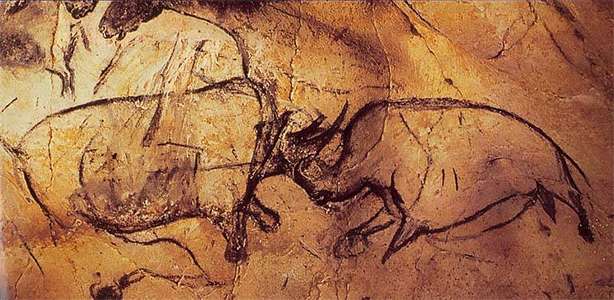
I am just back from Werner Herzog's extraordinary Cave of Forgotten Dreams, his exploration, visually and philosophically, of the Chauvet cave in southern France. There, in 1994, a collection of prehistoric art was discovered by three explorers who found a small opening in a cliff and soon were face-to-face with an almost unfathomable array of paintings. The French government immediately closed access to the cave to all but a select group of scientists and historians. Herzog's film, presented in vivid 3-D, is the closest any of us is likely to get to the art.


The paintings in Chauvet are more than 30,000 years old, making them nearly twice as old as those in Lascaux or Altamira, Europe's other great caches of Paleolithic art. They were made by our Cro-Magnon ancestors, literally at the dawn of Homo sapiens. When the paintings were created, Neanderthal man was not yet extinct.


The implications of this are profound, suggesting there is no gap between the emergence of modern man and the appearance of artistic expression. Art is intrinsic to our being. Imagination shaped our identity.

  
Perhaps the most extraordinary aspect of the paintings is their realism. The creatures in Chauvet are rendered with a remarkable level of detail and precision that Herzog's 3-D cameras richly reveal. The Chauvet artists expressed volume and mass with a highly sophisticated sense of modeling and chiaroscuro. There is a precise balance to the animals, even a kind of poise, and a sense of movement suggested through posture and the repetition of limbs or horns, almost a proto-animation. By far the most moving element of the paintings are the animal's eyes, which, through careful rendering of shape and size and gradation of light, seem filled with life, and an awareness that occasionally borders on pathos.


Throughout the picture Herzog describes the images as paintings, but I kept regarding them also as drawings, which raised an interesting thought. In the Renaissance there was a philosophical distinction between painting and drawing; painting being the expression of immediate, fleeting perception, drawing the contemplation of essence. Drawing was more than the definition of form; it was a revelation of underlying principles. There are moments in Chauvet when the same insight seems to be at work. Far from merely recording reality, these cave artists seem to probe it, and have already begun interrogating the meaning of life.


That this appears to be true, that from our earliest days art has been a way we created meaning, is suggested in the cave's most provocative image, dubbed by archeologists the Minotaur. The picture, drawn on a suspended pendant of rock, depicts a bison embracing a female figure. The naked woman, the only human depiction throughout the massive cave, evokes paleolithic carvings of Venuses, those primal effigies of sexuality, fertility, creation. The Chauvet Venus is represented only by her pubic triangle and legs, slightly spread. The bison appears to enfold her in an attitude of tenderness, contemplation, and what can only be described as wonder. Gazing at this picture is like being present at the birth of myth, the emergence of the collective unconscious.


This is the miracle revealed in Cave of Forgotten Dreams. Along with an astounding treasury of human ingenuity, Herzog's film presents us with the earliest expressions of our soul.

25 June 2011

A Candle for Christchurch

On February 21, a disastrous earthquake struck Christchurch, New Zealand, the country's second largest city. More than 180 people perished, great swaths of the city were damaged, thousands of people were uprooted, and much of the central business district was destroyed and is in the process of being demolished. The quake attracted the world's attention for three weeks, until Japan was devastated by an even more severe earthquake, tsunami, and ongoing nuclear disaster.


Since then, there has been almost no news about Christchurch in the US, leaving the impression that it's all over there but the clean-up. In fact, the city has been beset by an almost continual pattern of aftershocks, temblors, and convulsions these past four months. In some parts of the city water and electric service remain fragile. Residents have proved amazingly resilient, but the emotional toll of living under such conditions must be beyond imaging.  On June 13, the city was rocked by two more quakes, one equal in magnitude to the February event.


Three days ago, on 21 June, Christchurch residents were settling into their longest night, the winter solstice, when still another earthquake hit, once more knocking out power to a population with frayed nerves and strained resources.


The human story always lies beyond the headlines, in the day-to-day struggle to survive, endure, build, and rebuild. Remember the people of Christchurch, that their nightmare will soon come to an end. If you pray, include them in your prayers. If you light candles, touch a flame to a wick. If you drink, raise a glass to better days. No action is lost to the universe.

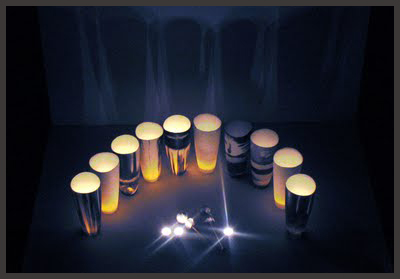
Claire Beynon, Candles for Christchurch

Christchurch photos (3), New Zealand Herald

26 May 2011

Unity is our essence


At the same time, however, the relationship to the world that ... modern science fostered and shaped now appears to have exhausted its potential. It is increasingly clear that, strangely, the relationship is missing something. It fails to connect with the most intrinsic nature of reality and with natural human experience. It is now more of a source of disintegration and doubt than a source of integration and meaning. It produces what amounts to a state of schizophrenia: Man as an observer is becoming completely alienated from himself as a being.—Vaclav Havel


It is becoming clear to almost anyone who thinks critically about it that science as we have long understood it is no longer equipped to address the challenges of the future. This is not to say that researchers and innovators in laboratories around the world may never come up with a carbon-neutral replacement for gasoline or a safe way to dispose of nuclear waste, or that the age of medical breakthroughs is behind us. But the notion of traditional science as the dynamo of something called "progress" feels pretty much used up. Utopian visions of societies operating justly and efficiently on the ball bearings of technology are artifacts of the past, and there isn't a school child alive who doesn't see that the old mechanistic ideas of scientific thought are as responsible for our current crises, human and environmental, as they were useful in eradicating the pestilences of old.


We are in the midst of an unmistakable evolution of consciousness toward higher orders of compassion, cooperation, and love. This statement may seem willfully foolish given the intractable woe that exists everywhere, be it warfare, displacement, human trafficking, state-sanctioned rape, mass poverty, or any of the other countless horrors around the globe. Yet life is governed by laws of polarity, and the more monstrous humanity behaves, the more urgent becomes its need and response. The rise in a collective movement toward compassion is inspired in part by the crises of sustainability we as a race and a planet face. As populations grow and the biosphere depletes, as resources dwindle and distorted power structures appear to exploit them, people in every part of the world are waking up to the failure of the old systems and the imperative for a new way based on different values.

In this regard, the age of science as both ideology and faith must give way to something more humanistic and humane. Science as a model for how to engage and steward life has proven fatally flawed. Instead of empiricism's simplistic cosmology of predictable and controllable cause and effect, we live in a world of chaos, collateral damage, and unintended consequences. There are those who still believe human intellect, with the aid of supercomputers and nuclear microscopes, can think its way out of the labyrinth of life's ever-creative repertoire of complexity. Beside them, however, is an ever-growing movement turning instead to the intelligence of the heart, our remarkable fist-sized blood pump which is also the seat of our courage, kindness, and boundless power of love.

None of what I have written is in any way a repudiation of science per se, nor a turning away from its core value of discovery. Nor are the sentiments of Vaclav Havel, in the address quoted at the top of this post. This extraordinary speech, given in Philadelphia on Independence Day, July 4, 1994, was a prescient early expression of the awareness that has grown in the seventeen years since he spoke. “I think there are good reasons for suggesting that the modern age has ended," Havel said that day. "Today, many things indicate that we are going through a transitional period, when it seems that something is on the way out, and something else is painfully being born. It is as if something were crumbling, decaying, and exhausting itself, while something else, still indistinct, were rising from the rubble.”

The thing "rising from the rubble" is a greater understanding of the connection between observation and being, scientific law and human integrity, existence and love. "Inspiration for the renewal of [our] lost integrity," Havel said, "can once again be found in science, in a science that is new—let us say postmodern—a science producing ideas that in a certain sense allow it to transcend its own limits."

The idea that such a science is at hand forms the foundation for Tom Shadyac's documentary I Am. The film chronicles Shadyac's exploration of the new paradigm, conducted through interviews with leading intellectuals, scientists, and writers. By the end, the director discovers that, indeed, the world's great wisdom traditions had it right—we are all connected, and our connectedness is at the heart of our humanity. He sets his course not by religion or philosophy, however, but by conclusions gained from quantum physics, neuropsychology, evolutionary biology, environmental studies, and noetic science, the emerging study of the interface of consciousness and matter.


Shadyac begins by going back to Darwin, whose concepts of natural selection were popularized to assert the influence of competition  over caring, a claim that was quickly extended into the spurious realm of "social Darwinism." Darwin made no such cultural claims himself, and many after him have observed that successful mutual aid among animals and humans is as much a definition of "fitness" as individual dominion. The idea that humans are wired as much to cooperate as compete has been bolstered by the discovery of mirror neurons, tiny brain receptors that make empathy possible, and the action of the vagus nerve (actually a pair of nerves) which, when we witness an act of kindness, releases oxytocin, a hormone related to nurturing and orgasm.


Shadyac ups the ante when he visits the Institute of HeartMath, a research organization that has, through controlled experiments, amassed evidence that the heart truly is one of the body's centers of intelligence. One of the film's memorable moments comes when the director's negative emotions apparently cause a dish of yogurt to emit its own negative feedback. It's the humorous illustration of a serious point, that emotions are physiological as well as psychological, and that kind thoughts alone can impact the behavior of others. I Am evokes the notion of quantum entanglement—the fact that atoms at an infinite distance react to certain stimuli simultaneously—to demonstrate the level at which all living stuff is quite literally connected. There is no separation, not of distance or time; in tracking the inert element argon, a part of earth's atmosphere, scientists have even concluded that we all breath the same air, and have since time out of mind. 


The conclusion is inescapable: unity is our essence. This idea is supported by a growing weight of fact, and to believe it is no longer the stance of the dreamer, but of the enlightened thinker. This is Shadyac's conclusion and his film's manifesto. The movie ends by asking how we can change society; the answer: through a change in consciousness. Knowledge is transformational. Shifts in awareness produce changes in attitude. The process is natural and inevitable.


Here is where the artist becomes key. Artists, with their ability to express the subtlest and most complex truths, are called now to the forefront of the new consciousness, called to clarify, to illuminate, and to express. What is "art for art's sake" beside this vocation? The Dalai Lama, asked to name the most important meditation of our age, answered, "critical thinking followed by action." More persuasive than propaganda, this is how art will change the world. 


Michelangelo, Phaeton, British Museum
Vaclav Havel, c. 1990, Council of Europe

03 May 2011

"I Will Not Rejoice in the Death of One"

In the aftermath of the US killing of Osama bin Laden, a quote attributed to Martin Luther King has been making the rounds in cyberspace. Here's how it came to me via Facebook:

"I mourn the loss of thousands of precious lives, but I will not rejoice in the death of one, not even an enemy. Returning hate for hate multiplies hate, adding deeper darkness to a night already devoid of stars. Darkness cannot drive out darkness: only light can do that. Hate cannot drive out hate: only love can do that." -Martin Luther King Jr.

Curious to know when and in what context King said something so startlingly congruent with my own feelings today, I went — where else? — to Google. But all I could find were variations on the quote, disembodied from any larger source.

Then I found this, by Megan McArdle of the Atlantic: Out of Osama's Death, a Fake Quotation is Born. "Something about it just strikes me as off," McArdle says about the quote. She goes on to assert she can't find the quote anywhere on the Internet, and concludes it was made up.


But not so fast. Sifting through the rubble we call the World Wide Web, I found evidence that contradicted McArdle, at least to an extent. Someone referenced a passage from King's book Strength to Love, a collection of meditations on nonviolence he published in 1963. In a chapter titled "Loving Your Enemies," King did express at least part of the quote. Here's the section, which follows a discussion of the differing Greek terms for love, eros, phila, and the one King is interested in, agape, which he defines as "creative, redemptive goodwill for all men." I took a screenshot of the text from Google Books:


So the quote making the rounds isn't entirely specious. Intrigued now with what else the Internet would yield, I dug a bit deeper and discovered an earlier evocation of the same idea by King, using much the same language. On Martin Luther King Online, I found the text of a sermon he delivered on November 17, 1957, also titled "Loving Your Enemies." The passage in question comes up in the lesson of a modern parable:


I think I mentioned before that sometime ago my brother and I were driving one evening to Chattanooga, Tennessee, from Atlanta. He was driving the car. And for some reason the drivers were very discourteous that night. They didn’t dim their lights; hardly any driver that passed by dimmed his lights. And I remember very vividly, my brother A. D. looked over and in a tone of anger said: "I know what I’m going to do. The next car that comes along here and refuses to dim the lights, I’m going to fail to dim mine and pour them on in all of their power." And I looked at him right quick and said: "Oh no, don’t do that. There’d be too much light on this highway, and it will end up in mutual destruction for all. Somebody got to have some sense on this highway."
Somebody must have sense enough to dim the lights, and that is the trouble, isn’t it? That as all of the civilizations of the world move up the highway of history, so many civilizations, having looked at other civilizations that refused to dim the lights, and they decided to refuse to dim theirs. And Toynbee tells that out of the twenty-two civilizations that have risen up, all but about seven have found themselves in the 
junkheap of destruction. It is because civilizations fail to have sense enough to dim the lights. And if somebody doesn’t have sense enough to turn on the dim and beautiful and powerful lights of love in this world, the whole of our civilization will be plunged into the abyss of destruction. And we will all end up destroyed because nobody had any sense on the highway of history. Somewhere somebody must have 
some sense. Men must see that force begets force, hate begets hate, toughness begets toughness. And it is all a descending spiral, ultimately ending in destruction for all and everybody. Somebody must have sense enough and morality enough to cut off the chain of hate and the chain of evil in the universe. And you do that by love.
So this concept of darkness begetting darkness, hate begetting hate, was an idea MLK had been developing over the years, borrowing and slightly modifying his phrasing as he went along. Knowing this, I'm not at all sure King did not say the words quoted by my Facebook friend. He may well have spoken them, and if he did, my guess is it would have been near the end of his life, when he had turned his attention to broader issues of peace and justice, and was speaking out against the Vietnam War. Gut feeling.
All this is by way of broaching the larger issue, which is how to feel in the wake of Osama bin Laden's swift and sudden death. And in this I find myself torn. Viscerally, I cannot regret bin Laden's fate. Not long ago, I listened to Homer's Iliad, the whole long poem, while driving back and forth two hours a day to a work project. As Homer graphically demonstrates, bloody vengence is as much a part of our Western tradition as Christian agape. Every one of the great Greek heroes took what you could only call sadistic delight in vanquishing the enemy in a stunning array of brutal, violent actions. Something there is in mankind that loves revenge. I'm just — I don't know what, American enough? male enough? human enough? — to thrill a little at the idea of our guys storming Osama's compound and taking him out.
But I get no lasting satisfaction from my own thrill. It comes back on me with a bitter taste. In my heart, I agree with Martin Luther King, however much of that opening sentiment he actually uttered. The reason the quote has gone viral is because there is wisdom in it, wisdom born of compassion, dignity, and respect for human life. The demands of love require us to, at the very least, be sober in the face of what took place in Pakistan on the first of May. In the 1957 sermon, King addresses this concept of love:
You look at every man, and you love him because you know God loves him. And he might be the worst person you’ve ever seen.
And this is what Jesus means, I think, in this very passage when he says, "Love your enemy." And it’s significant that he does not say, "Like your enemy." Like is a sentimental something, an affectionate something. There are a lot of people that I find it difficult to like. I don’t like what they do to me. I don’t like what they say about me and other people. I don’t like their attitudes. I don’t like some of the things 
they’re doing. I don’t like them. But Jesus says love them. And love is greater than like. Love is understanding, redemptive goodwill for all men, so that you love everybody, because God loves them. You refuse to do anything that will defeat an individual, because you have agape in your soul. And here you come to the point that you love the individual who does the evil deed, while hating the deed that the person does. This is what Jesus means when he says, "Love your enemy." This is the way to do it. When the opportunity presents itself when you can defeat your enemy, you must not do it.
It is not necessary that we grieve for bin Laden, but I do not see how we can rejoice either. I wish we would have taken him alive, brought him back to this country and put him on trial, proved to the world that we are a country of laws, as we did in Nuremberg. There are conflicting reports from Washington in this point; some high level sources say taking him alive was an option, others say it was not. I hope the latter is true, and that this wasn't an assassination mission. In any case, to revel in so violent a death is poisonous to our national soul. On this point, King was powerfully eloquent in 1957. He understood hatred as being most destructive to those who exercise it:
There’s another reason why you should love your enemies, and that is because hate distorts the personality of the hater. . . . There is nothing more tragic than to see an individual whose heart is filled with hate. He comes to the point that he becomes a pathological case. For the person who hates, you can stand up and see a person and that person can be beautiful, and you will call them ugly. For the person who hates, the beautiful becomes ugly and the ugly becomes beautiful. For the person who hates, the good becomes bad and the bad becomes good. For the person who hates, the true becomes false and the false becomes true. That’s what hate does. You can’t see right. The symbol of objectivity is lost. Hate destroys the very structure of the personality of the hater.


A decade later, in 1967, as riots were tearing US cities apart, King reaffirmed his belief in nonviolence:

I'm concerned about justice. I'm concerned about brotherhood. I'm concerned about truth. And when one is concerned about these, he can never advocate violence. For through violence you may murder a murderer but you can't murder murder. Through violence you may murder a liar but you can't establish truth. Through violence you may murder a hater, but you can't murder hate. Darkness cannot put out darkness. Only light can do that.

As we stand proud in this blow stuck against international terrorism, we might try standing tall too, and denounce hatred in all its forms, in thought, word, action, and reaction. That includes the varieties of hatred we are now seeing around this country wearing the cloak of patriotism.   


22 April 2011

Tim Hetherington II

From Sebastian Junger's meditation on his colleague and friend, who was killed this week in Misrata, Libya, photographing the war there:

Maybe Misrata wasn’t worth dying for—surely that thought must have crossed your mind in those last moments—but what about all the Misratas of the world? What about Liberia and Darfur and Sri Lanka and all those terrible, ugly stories that you brought such humanity to? That you helped bring the world’s attention to?
After the war in Liberia you rented a house in the capital and lived there for years. Years. Who does that? No one I know except you, my dear friend. That’s part of Misrata, too. That’s also part of what you died for: the decision to live a life that was thrown open to all the beauty and misery and ugliness and joy in the world.
And the rest:
 http://www.vanityfair.com/magazine/2011/04/sebastian-junger-remembers-tim-hetherington-201104?printable=true#ixzz1KIQWNiQ8

21 April 2011

In Memoriam: Tim Hetherington

I woke this morning to the sad news that documentary filmmaker and photographer Tim Hetherington lost his life yesterday in Misrata, Libya, covering the fighting between the army of Muammar Gadaffi and opposition rebels. The British-born Hetherington and an American colleague, photojournalist Chris Hondros, were both killed by a rocket-propelled grenade fired by Gadaffi forces.

Hetherington will long be remembered as a consummate war photographer and humanitarian. He trained his lens less on the drama of battle than on the terror and psychological assault that defines the war zone.  Among the work on his website are portfolios of the civil war in Liberia, of war graffiti, and perhaps most subtle and affecting, a portrait series of US soldiers asleep in their outpost camp on the front lines of the Afghan war. In their faces and postures, Hetherington recorded the trauma many of these men are sure to carry long after their wartime service ends.

In Darfur Bleeds, a brief film made by Hetherington for Human Rights Watch, the humanitarian concerns that motivated his work are fully on display. The film documents the destruction of a village in Chad, ostensibly demonstrating how the war had spilled over the border from Darfur. But Hetherington refuses to turn the event into an abstraction, and pays moving tribute to the individuals who perished in the attack.


I had the good fortune to meet Hetherington this past July, when he was at the New York State Museum screening Restrepo, the documentary he made with author Sebastian Junger about American soldiers in the Korengal Valley of East Afghanistan. I had more than a general interest in the film. At the time, I was preparing the photo exhibition Battlesight , and knew the work of one of the photographers in the show, Balazs Gardi, depicted the same part of Afghanistan where the film was made. Indeed, as I discovered, Balazs's photographs were of the identical Army unit and villages in Korengal, even of the same four-day battle seen in the movie. It was remarkable; more than one combat scene in Restrepo was also documented in Balazs's powerful stills, and Balazs is among those acknowledged by Junger and Hetherington in the end credits.

Hetherington and I arranged to do a telephone interview a few days later, when he was back home in New York. He was called away before the interview was completed, so it went unpublished. I looked at it again today, and feel now as I did then, that I was speaking to an exceptional and courageous artist and man. In Hetherington's memory, I offer excerpts of that conversation now. It begins with my question about a scene from the film.


There’s a moment in Restrepo, just after one of the soldiers has taken fire. He’s almost giddy from the experience, and says, “Once you’ve been shot at, you can’t come down.” Somebody off-camera asks, “How are you going to go back to the civilian world?” “I have no idea,” he answers. Talk about that moment, that experience. Do you feel the same sense of a high in a war zone?

Tim Hetherington: When you hear what that man is saying in that clip, he’s specifically talking about the adrenalin of a battle. But I think for many of the soldiers there, the group experience of what they went through, that bombing, was very meaningful to them. I mean, if you take an 18-year-old and he’s part of that group, and the job he’s tasked with is defending the group, his life takes on a purpose and a significance, a meaning, that must be extremely gratifying. Then when that 18-year-old comes back to America, to society, suddenly he loses all that sense of purpose and meaning. I know many of the guys miss that meaning and significance.

I think it’s the same way with journalists­—I know, for myself, that sure, adrenalin is a part of the experience. When I came out of Afghanistan in August 2008, it was like someone had pulled the rug from under my feet because I had been drip-fed adrenalin. So chemically that does something to you. But on the other hand, covering world events, covering these situations, gives your life a kind of meaning as well. It’s very gratifying to be at the center of world events as they unfold. You feel that you have some kind of significance. That is part of the reason you keep going back. It’s not purely a combat adrenaline thing; it’s more than that. And for Sebastian and I, we got close to these guys. That’s why, when I came out of Afghanistan, I missed them. I missed being up at Restrepo.

So there’s a sense that what you’re doing has a purpose, that it’s useful?

You’ve totally hit the cornerstone of my work. I always wanted to be useful and add utility. That’s why, as I’ve said before, I’m really not interested in photography, the art. I recognize that it is an aesthetic medium, so I pay attention to that. But the craft of it isn’t my primary concern. I’m not interested in the craft and art of photography per se; I’m interested in visual communication, and that ranges from the still to the moving image.

You have that perspective of working in these two related, but very different mediums. What are your thoughts about that?

The still image offers the audience a greater imaginative engagement with the subject. You look at a picture, you have to enter into a conversation with the image. That conversation is predicated on a lot of different things—your own personal experience, what you see in the picture, but also your own visual library, what you have stored in your head about the subject matter you’re seeing. When you see a moving image, especially video contextualized with sound, you’re literally being dragged through the experience. You’re not imaginatively as engaged in that. You’ve being shown something that’s more concrete. 

I’m from the photographic trade; that’s part what I do, and I understand the strengths and weaknesses of it. I think [the photojournalistic] community is caught up with the aesthetic craft of image making more than what it says. We don’t unravel enough what images say; we’re too held up on the surface level. The problem with photographs is that they can be an unreliable form of witnessing. I understand we all want to believe in the veracity of a photograph. I have a photograph of my mother on my mantelpiece. I want to believe that that image is true. We need to believe images are true. I get that. But as the actual makers of images, if we are engaged professionally in the business, we have to understand that that is also a fallacy.

What did making Restrepo teach you about warfare, about yourself, and, more broadly, about humanity?

We sought to really mine the embedded process, deeper than anyone had mined it before, in terms of the amount of time we spent with the guys, the way we embraced the unit, for all intents and purposes became part of the unit. That was a very profound experience. I had never done that before. I had been embedded with a rebel army in Liberia for six weeks, but never reached that kind of connectedness with the individuals. As a documentarian, either still or moving images, you seek to have this very, very close connection with your subjects, and I really had that with the soldiers out there. Following on from the subject of young men and war, which is a subject I’ve been preoccupied with for some time now, I really came to understand how this bonding, this sense of brotherhood that soldiers attain, that that is really the heart of the war machine. You take a small group of guys, you get them to train together, live together, bond together, they form this brotherhood. This isn’t friendship. This is brotherhood. Guys in the unit admitted they hated each other, but they would die for each other. It’s this sense of brotherhood that’s the cornerstone of the war machine. It’s not Apache helicopters or aircraft carriers or missile defense systems; that is all icing on the cake. This sense of a small group of young men who will kill and be killed for each other is at the heart of it. That goes back to time immemorial. The siege of Troy would be the same thing. It’s an obvious thing but also quite a profound thing when you start to understand that.

Tim Hetherington at the New York
State Museum, July 2010

18 April 2011

Love and Justice

Hugo Perez
For the past week I have been ruminating on what was in every way a fine and moving evening last Tuesday, when we screened Hugo Perez's Neither Memory Nor Magic, a film portrait of Hungarian poet Miklós Radnóti. I had moist eyes more than once as I watched this beautiful and poignant work, which, though it depicts the life of a man who died miserably in the Holocaust, is ultimately about life, not death; courage, not fear; beauty, not brutality. Radnóti's poems, the few I know from the film and from Carolyn Forché's anthology Against Forgetting: Twentieth Century Poetry of Witness, have burrowed deep into me. He bore witness to the barbarity of the Nazi labor camps where he was imprisoned, with a voice at once elegiac and indomitable, and though he never flinched from the horror of his circumstance, his poems ultimately are expressions of profound love. Love for his wife Fanni, for the music of language, for the world:

. . . tonight the moon is so round!
Don't go past me, my friend— shout! and I'll come around! 
                                                                              
I was just admiring, up there, your eyes' blue sheen,
when it clouded over, and up in that machine
the bombs are aching to dive. Despite them, I am alive

My definition of the "documentary arts" is broadly inclusive, as evidenced in the mission state on this page; it's meant to embrace all art that bears witness to the struggle, striving, and triumph of the human spirit. Bearing witness in this sense is no passive, legalistic stance. It demands an active engagement with the world and, perhaps more deeply, a committed relationship to soul. As Forché writes in the introduction to her book, witnessing art "will have to be judged . . . by its consequences." Among the consequences must include art's ability to advocate for life, to stand on the side of compassion, generosity, care; in short, to love. As a position, this is not at all simple or easy. The instinct of a great many artists who fall loosely under the heading "documentary" is, I observe, not toward love as much as justice. I once asked the poet Hayden Carruth which of those two imperatives was "more important"; he declared in favor of justice, since justice implied love. I'm not entirely sure I agree with his choice, but the logical equation is not at all straight-forward: all love may encompass justice, but too few things that pose as "justice" can be said to espouse love. Indeed, the concept of justice is commonly defined according to the duality of good and evil, a useful dichotomy if one is in need of enemies or dominion, but not one that accommodates grace. Grace, simply put, is treating others not necessarily as they "deserve," but as love requires — as fellow travelers on a divine journey. This is a radical notion, one that runs counter to logic and experience, yet it seems to me just where we can situate Radnóti, and where the artists I most admire reside. This does not mean I take no interest in art that seeks to expose injustice or address suffering. Far from it. That is also an act of witness. Yet I have long believed, and maintain more strongly now than ever, that art's greatest power is not as a mirror, but as a torch, beacon, guide, path — whatever metaphor works for you — to higher consciousness. Art elevates humanity not so much via the enlightenment of argument and evidence as through the illumination of the soul's mysteries and wisdoms.

This is what Hugo's film accomplishes. There are passages in it as moving as any I've seen in a documentary film; in one, the screen painfully dissolves to black, a darkness broken by one of Radnóti's poems like a herald from heaven. I want to express my gratitude to Hugo for his work and for being my guest in Albany, and thank all those who attended and stayed for the lively Q&A afterward. More screenings are planned for the future; the Opalka Gallery, my partner in last week's event, will be co-host and venue for a series of four films beginning in October. I am currently programming that series and will have more information to share on it shortly.

The audience during the Q&A


Poetry excerpts from "Forced March" and "Letter to My Wife," translated by Emery George, from Against Forgetting: Twentieth Century Poetry of Witness, edited by Carolyn Forché. 

04 April 2011

Neither Memory Nor Magic: Part II


I fell beside him; his body turned over,
already taut as a string about to snap.
Shot in the back of the neck. That's how you too will end,
I whispered to myself; just lie quietly.
Patience now flowers into death.
Der springt noch auf, a voice said above me.
On my ear, blood dried, mixed with filth.*

When Miklós Radnóti's body was discovered in a mass grave in 1946, he had been dead a year and a half, one more of the staggering millions who perished in the shadow of Hitler between 1939 and 1944. Unlike most of the victims, however, Radnóti did not vanish after death nor remain silent. Already celebrated in his native Hungary as an important poet before his internment in German labor camps, Radnóti rose like a phoenix to bear witness to all he endured as an enslaved prisoner. When his body was exhumed, his wife found a small notebook in his pocket that contained his last poems, and many of his greatest. The so-called Bor Notebook, named for the Serbian copper mine where it was begun, is one of the twentieth century's abiding testaments of artistic courage amid barbarity and suffering. The poems Radnóti composed in Bor and on the forced march before his execution possess a strength, pathos, and compassion that take them even beyond literature, into the highest precincts of the human spirit.

On April 12, the Center for Documentary Arts will premiere an expanded and re-edited version of Hugo Perez's Neither Memory Nor Magic, a film portrait of Radnóti. The screening, presented in collaboration with the Opalka Gallery, will be shown at 6:30 in the gallery's theater, Sage College of Albany, 140 New Scotland Avenue, Albany. (If you haven't read my previous post about the event, there is additional information and a trailer there about Radnóti and the screening.) This is a proud moment for the Center for Documentary Arts; Hugo Perez is a gifted young filmmaker whose work is insightful and visually beautiful, and the opportunity to see this film in the intimate setting of the Opalka theater, with the director in audience, is a rare privilege. Perez and Radnóti each embodies the Center's humanitarian mission with work that speaks to individual conscience and calls us to empathy. Radnóti's poems are creative acts so potent they leave you changed. The same can be said of Perez's film, which was awarded the prestigious Chairman's Award of the National Endowment for the Humanities.


. . .  Lonely the vigil I'm keeping;
in my mouth I taste that half-smoked cigarette, not your
kisses, and dreams won't come, no sleep will come to relieve me,
since I can face neither death nor a life any longer without you


Neither Memory Nor Magic—the title comes from a Radnóti poem—has been eight years in the making.   Perez traveled to Hungary and Serbia to visit the places where the poet experienced his greatest triumphs and most desperate hours. He interviewed more than fifty people, including friends who knew Radnóti in Budapest before the war and a fellow inmate who shared the horrors of Bor. A poignant image early in the film shows an exhibit in a Hungarian school in which Radnóti's poems are displayed impaled on barbed wire. Later, Perez is welcomed by Radnóti's widow Fanni into the apartment where the couple lived together. And flowing like a strong current through the film are the poems themselves, which voice their author's hopes, joys, fears, anguish, and finally surrender in language both humble and haunting.


For its art, for its humanity, and for its portrait of grace in the face of brutality, this is a film not to be missed.


Hugo Perez, right, interviews Ferenc Andai in Serbia,
where he was interned in a forced labor camp with Radnoti


Perez graduated from Yale University in 1993 with a degree in English. His training as an artist began in Little Havana, Miami, amid relatives who fled Cuba after the revolution. He grew up suffused with a sense of exile, yet entirely at home among the movies and stories of his native country, America. His Hispanic heritage is the occasion for some light irony in the name of his film company, M30A. The appelation derives from the Latin American custom of naming a revolution after the day and month it was started. In Perez's case, the revolution was the launching of M30A itself, which took place the next to the last day of August 2003. 
I spoke to the filmmaker earlier this month as he was putting the finishing touches on NMNM.


TC:  What is the genesis of your film?


Hugo Perez: You could say that it started in Saratoga Springs, New York in the summer of 1996, when I had the pleasure of meeting Carolyn Forché and was introduced to her anthology Against Forgetting: Twentieth Century Poetry of Witness. The whole idea of that book is that poetry can be almost documentary in nature, a poem can be like a mini-documentary. The book covers the twentieth century from Armenia to Rawada through the eyes of poets. This idea of poetry as witness was one I was quite taken with. Right in the middle of the twentieth century—right in the middle of the book—is the Holocaust, and one of the poets featured in that section is Miklós Radnóti. In fact, the story of the Bor notebook is the story she starts out her introduction to the entire volume with. The first couple pages are about Radnóti, and the notebook coming out of the grave. I read it and was really moved by it. Then eight years went by. I met this guy named Gregory Carr, who had a foundation called the Carr Foundation and at that time was interested in supporting documentary film. He asked if I had any ideas for a documentary that would celebrate the power of poetry. That’s perhaps the only time I’ve ever been asked that question, and will likely be the only time for the rest of my life. He asked with the intention that he was looking for a film to support. I thought back to Against Forgetting, I sent him a copy of the book, we talked about it some more, and we decide that Radnóti’s story captured the essence of poetry of witness. Ultimately, the foundation wound up supporting my film. Sometimes you choose films, and sometimes films choose you.


Why Radnóti, of all the poets in the anthology?


A couple of things. There isn’t anything else like the story of the Bor notebook. Literally, his final poems were in a grave for a year and a half before anybody saw them. His notebook with his final poems were soaked in his blood, blood of a poet. It adds a special drama and quality to his particular story. And also the fact that it was the Holocaust, this monumental moment of evil—it captures everything we were trying to say about poetry in the twentieth century.


What was it you wished to say?


In the case of Radnóti, in the last weeks of his life he must have known he was going to be killed. He must have known that perhaps nobody would ever see these poems he was writing. And yet he continued to write. He wrote four poems while he was on a two-month death march, before he was shot into a mass grave. To me that’s very powerful— even when you’re a week away from your death and can barely walk, you care enough about what you do, and believe in it enough, that you write a poem. As a poet, as a writer, you can’t focus on the outcome of your work, who’s going to read it. There’s something about the act of setting things down, putting pen to paper, that is meaningful in and of itself.


And the documentary was a way not just for us, but for you yourself to come to know this man?


I went in not as a scholar but as a filmmaker and storyteller. I wasn’t looking to make the definitive statement on Radnóti. I was trying to find connections that would help me understand him and the story of his world in a way I could present to audiences. Over the course of a couple years, I was back and forth to Hungary six or seven times, we interviewed more than fifty people, including a handful of people who had known him; I literally walked in the same places he walked. I went to Serbia to see the Bor copper mine, where he was a slave laborer. We followed the course of the last hundred kilometers of the death march, the different places where he stopped and he camped. There’s not much left of that time, but you get a connection of the geography, the place he was in, the sky that he saw. The film is episodic in nature, especially the last forty minutes, it’s a string of little stories that take you from the labor camp to the death march to his death and after his death. There’s a voice in each of those little segments that takes you through.


The film is a portrait of artistic courage and a love story between the poet and his wife Fanni.


Oh, definitely. One of the great privileges and pleasures of this trip was getting to meet and spend time with Fanni Radnóti, who is still alive today and still lives in the apartment they shared together. She had never done an interview. She has really been the keeper of the flame for Radnóti, she has assured that his legacy lives on. Every significant project on him that has happened as happened with her blessing or some conversation with her. I tried to get her to give me an interview and she wouldn’t. I finally persuaded her to let me film her, which I use as the ending of the film.


How did the experience enhance your understanding of Radnóti's poems?


When I read his work, it felt very personal, like he was speaking to me. Making the film helped me understand his world better. The thing I came to understand more was how he developed into who he was. He was Jewish by birth but not by culture. He was a very secular guy who as a teenager got introduced to the great Hungarian poets, and decided he wanted to be one of them. He went and he made himself into a great poet.


* Excerpts translated by Emery George, from Against Forgetting: Twentieth Century Poetry of Witness, edited and with an introduction by Carolyn Forché.

Giotto's Kiss

I'm thinking on this day before Christmas about  Giotto's depiction of the reunion of Joachim and Anne, Mary's parents, at the G...