It is with pleasure I can report that Battlesight is on two end-of-year "Best-of" lists.
David Brickman, in his blog Get Visual, named our exhibit in his Best Shows of 2010:
Battlesight: Dispatches from Iraq and Afghanistan by International Photographers stood out as a hard-hitting, carefully planned combination of three photojournalists’ personal visions of war (oddly enough, it’s the only show of photographs that made this list).
And via Nippertown!, The Daily Gazette's Karen Bjornland included Battlesight in her recap, What We Loved This Year: Visual Arts.
Thank you, David and Karen (and friends at Nippertown!).
And thank you to all who helped me and the Center for Documentary Arts during our first year of operation. I am grateful to you one and all. And so we look toward 2011. . .
30 December 2010


25 December 2010
Poets of compassion

 |
| from 1933 stage adaptation |
Warmest wishes of the holiday to all.
07 December 2010
Millstones
I was on Joe Donahue's radio program "The Roundtable" yesterday to talk about Battlesight. The station reaches seven states and I'm grateful to Joe and WAMC for the opportunity to speak about the exhibit and photographers before such a wide audience. Here's the link to listen.
Today is Pearl Harbor Day, which when I was a boy was a somber day of remembrance and reflection for people of my parents' and grandparents' generations. Today, the attack on the US Naval base by Japan in 1941 is less reverently observed, as those who were alive that day more and more pass from our sight. As the paradigm of a Day of Infamy, Pearl Harbor has, of course, been replaced in contemporary America by the terrible events of September 11, 2001. That day, which we watched unfold together on television, will remain vivid in our collective memory until our grandchildren are old.
As I wrote that last sentence, a black image passed through my mind, of some future event even more horrific than 9/11 searing a new standard of horror on our psyches. It's dreadful to conjure, but how can anyone who's paying attention completely avoid it? As much as we live lives of courage and confidence, it is difficult not to harbor some fear for our future, some dread that America will yet again be the site of a monstrous attack. In this regard, December 7, 1941, was the beginning of an epoch in our national history of the omnipresent enemy, the evil Other bent on destruction. Hitler, Hirohito, Stalin, Khrushchev, Ho Chi Minh, Brezhnev, Khomeini, Noriega, Saddam Hussein, Bin Laden, Ahmadinejad, Kim Jong-il -- an unbroken chain of adversaries, some erupting on their own, others cultivated by our government inadvertently or deliberately to fulfill the requirements of a military-industrial economy.

It's a staggering thought, that this country has spent the whole of my half-century and more pursuing enemies. When I was in my twenties, a wave of articles and movies appeared detailing the consequences of nuclear war, and a threat that had been in the background through my childhood took on new urgency. I am too young to have experienced "duck and cover" drills or known anyone with a bomb shelter in their back yard, though I do remember the yellow Civil Defense signs in the steampipe-lined catacombs of my elementary school which led to a storeroom of mattresses and slowly rusting cans of food. The Bomb was a vague threat in my consciousness during the 1960s and '70s, when Vietnam, street protests, and Watergate were much more immediate. In the 1980s, though, when we all learned the term Nuclear Winter, the feeling that civilization was provisional struck me deep. I remember a conversation I had at the time with an old New Englander about a great granite millstone we were admiring at a farm museum. "A thing like that'll last forevah," the man said in his Yankee inflection. "Or until the bombs fall," I thought to myself, shuddering at the notion we'd created a world where such a possibility existed.
My fear then was the product of a twisted manufacture, just as our fear of terrorist attack is today. That manufacture is a complex system of technology, ideology, economics, and propaganda. It is impossible for Joe Citizen to know how much of the threat is real and how much a construct. I swing wildly sometimes, from "recognizing" how dangerous the world is to suspecting the whole thing is a put-up job, created, as Lucy says in A Charlie Brown Christmas, "by a big Eastern syndicate." What I do know is that we will remain at the mercy of tooth and claw as long as we continue to choose conflict over cooperation. The way to enter a new epoch of peace is to be exemplars of justice and compassion. The question is, has nearly seventy years of being on the defensive changed our national personality in ways that prevent us from doing so?
02 December 2010
Bob Goepfert's "The Arts Whisperer"
A friend recently sent me this fine posting about Battlesight from the blog of the Troy Record's arts editor. How eloquently Bob relates his experience of viewing the exhibit:
There is an eerie beauty about the photographs individually and collectively. While I found myself being hypnotized by certain images - especially the 2007 photograph by Balazs Gardi which shows an Afghan man holding a wounded child - when I stood in the middle of the gallery and slowly turned 360-degrees I became immersed in the whole to the degree it felt like an out-of-body experience. The circle transported me not to Iraq or Afghanistan but to a surreal world where pain, fear and suffering was the norm. This place is called war.
The rest of the post is here. (Scroll down the right sidebar there to the list of past postings.)
Battlesight is on exhibit through December 19 at the Arts Center of the Capital Region in Troy.
23 November 2010
David Brickman's "Get Visual"
I'm still a bit dazed as I post this, by the generous and enthusiastic review of Battlesight from the Capital Region's premier art critic, David Brickman. Here is how he begins:
It's as though the International Center of Photography opened a branch in Troy. The exhibition Battlesight: Dispatches from Iraq and Afghanistan by International Photographers is that good, and that important.
An extraordinary endorsement. The rest is here: http://dbgetvisual.blogspot.com/
It's as though the International Center of Photography opened a branch in Troy. The exhibition Battlesight: Dispatches from Iraq and Afghanistan by International Photographers is that good, and that important.
An extraordinary endorsement. The rest is here: http://dbgetvisual.blogspot.com/
16 November 2010
Gallery Notes
Comments left by visitors after viewing Battlesight,
to Cheryl, Balazs, and Teru for their extraordinary work.


01 November 2010
Press: Albany Times Union
War with faces
By TOM KEYSER Staff Writer
Published: Friday, October 29, 2010
 |
The Blue Mosque, Mazar-e-Sharif, Afghanistan 2007 (Photo by Teru Kuwayama) The 32 photographs in “Battlesight: Dispatches from Iraq and Afghanistan by International Photographers,” which is the inaugural exhibition of the Center for Documentary Arts at The Sage Colleges, draw out an emotion that fulfills not only the mission of the show but also the mission of the center. “The show raises our consciousness, not about a certain political agenda, but about our fellow human beings,” says Timothy Cahill, the center’s director. “That gets to the big word, which is compassion/empathy. If you open yourself up and don’t come in with one agenda or another, if you just look at the pictures, I think it’s impossible to walk away not having connected to their humanity.” |
Press: The Daily Gazette & Metroland
| The Daily Gazette (Schenectady, NY), October 28, 2010 Photos capture physical, emotional impact of war Views of Afghanistan, Iraq wars bring home reality Thursday, October 28, 2010 By Joanne McFadden  TROY — One assignment, three different results, all poignant statements about humanity. That’s what visitors to The Arts Center of the Capital Region will see in “Battlesight: Dispatches from Iraq and Afghanistan by International Photographers,” the debut exhibition of the Center for Documentary Arts at The Sage Colleges. It will be on exhibit through Dec. 19. Timothy Cahill, founding director of the center, admits that there’s “something very brave about launching a not-for-profit devoted to documentary art and compassion in the midst of a great recession.” Yet he, along with founders Dr. Melvin Krant and Steve Lobel, did just that. “Battlesight” goes to the heart of the center’s twofold mission: to use documentary arts to bring viewers into the lives of other people and as a result increase awareness of what we share as humanity and foster increased compassion for one another. In part, Cahill chose the wars in Iraq and Afghanistan for the center’s first exhibition because it will be on view at the same time as The Sage College’s Veterans Week 2010, and this was a way to highlight the activities of the center’s host institution. Despite the subject matter, the exhibition is not a political statement. Neither it nor the Center for Documentary Arts has a political agenda, Cahill said. He chose three photographers who had worked in Iraq or Afghanistan on to give the public a closer look at what is taking place in that region of the world. “I wanted the show to begin to be a dialogue about various ways these artists take reality and mold it into something that’s truthful and communicate that truth,” he said. Full article here
ART MURMUR THIS IS WAR An exhibit opened at the Arts Center of the Capital Region (265 River St., Troy) last week that we all would do well to check out. Curated by Timothy Cahill, Battlesight: Dispatches from Iraq and Afghanistan by International Photographers is a powerful collection of war photography by Pulitzer Prize winner Cheryl Diaz Meyer, Balazs Gardi and Teru Kuwayama. The exhibit is on view through Dec. 19, but there will be a reception tomorrow evening (Friday, Oct. 29) from 5:30-9 PM during Troy Night Out.
|

23 October 2010
Battlesight: Installation
Battlesight: Dispatches from Iraq and Afghanistan by International Photographers
The Arts Center of the Capital Region, October 22 through December 19, 2010
Opening reception, October 29, 5-9 pm
The Arts Center of the Capital Region, October 22 through December 19, 2010
Opening reception, October 29, 5-9 pm


22 October 2010
Press: The Troy Record
The Troy Record, October 21, 2010
Art Center explores wars’ savage beauty
By Phil Drew
The Record
The Record
A man clutches a wounded child; both are grimy, peering out of darkness in the black and white photo. The man’s gaze is not toward the combat photographer who has snapped the image — embedded with U.S. troops fighting in the mountains and villages of eastern Afghanistan — but somewhere upward; toward an unseen soldier towering behind the cameraman, perhaps? Toward a bystander? Toward heaven?
Despite obviously severe wounds, the child appears calm, if grim, gaze directed the way as his protector’s. Are they imploring, accusing? Or simply presenting themselves to their unseen interlocutor, heavenly or worldly, proclaiming, ‘here I am,’ ‘deal with me?’ Crouching next to them, an older man touches the child; a doctor giving treatment? A village elder? A mullah? The youngster’s grandfather?
There is something almost spiritual in the pose of man and child, reminiscent of the ‘Pieta’ yet shockingly contemporary. And the man laying on hands? "Something almost, dare I say it, rabbinical about that," says Timothy Cahill, showing off the image by photojournalist Balasz Gardi – one of three independent photographers whose work is on display through Dec. 19 in the main gallery of downtown Troy’s Arts Center of the Capital Region.
"These pictures bring us to empathy," says Cahill. "It’s impossible to look at these photographs, to really look at them, and not, after going around the room, to feel connected with these other human beings."
Gardi’s work, along with that of Cheryl Diaz Meyer and Teru Kuwayama, makes up "Battlesight: Dispatches from Iraq and Afghanistan by International Photographers" – sponsored by the year-old Center for Documentary Arts at The Sage Colleges.
The images, curated by Cahill, the center’s founding director, are artful, beautiful photography, worthy of a gallery; but they are also reportage, unblinking, close-up, of the effects of war, psychological and physical and visceral. Their combined effect is not polemical and argumentative but a jolt of reality: "it strips us of abstraction," says Cahill.
Read full article here
12 October 2010
The card . . .
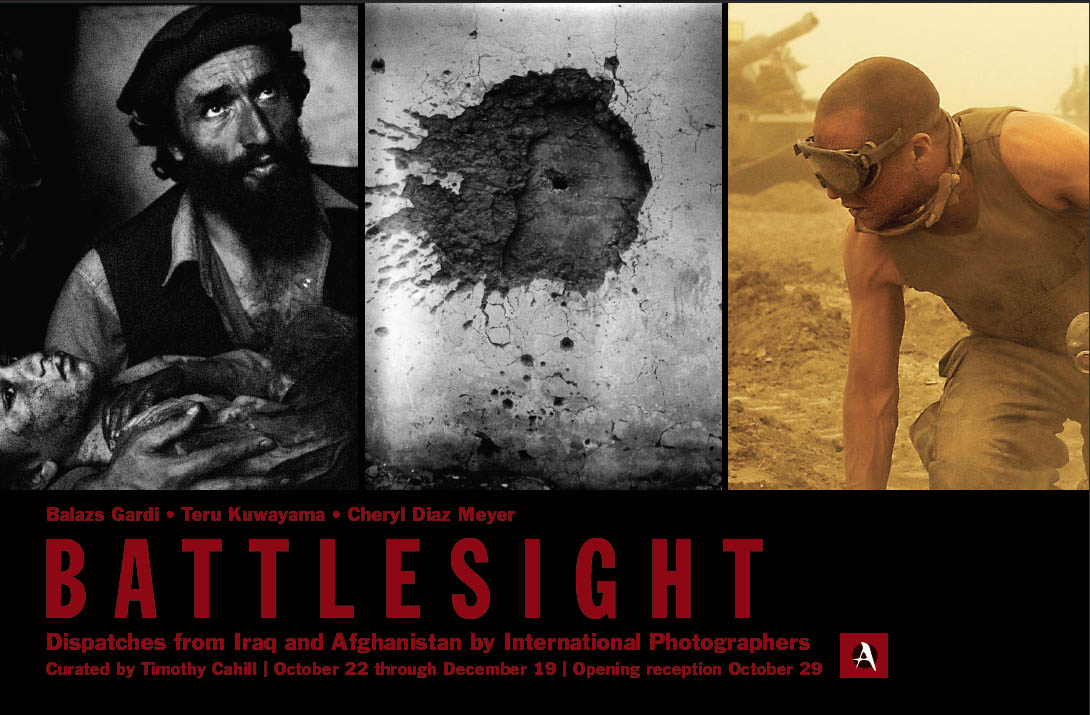 | |||
| Arts Center of the Capital Region, Troy, New York October 22 through December 19, 2010 Opening Reception, October 29 |
Subscribe to:
Posts (Atom)
Giotto's Kiss
I'm thinking on this day before Christmas about Giotto's depiction of the reunion of Joachim and Anne, Mary's parents, at the G...

-
 I fell beside him; his body turned over, already taut as a string about to snap. Shot in the back of the neck. That's how you t...
-
 In the aftermath of the US killing of Osama bin Laden, a quote attributed to Martin Luther King has been making the rounds in cyberspace. He...